 AI Tool
What is this tool?
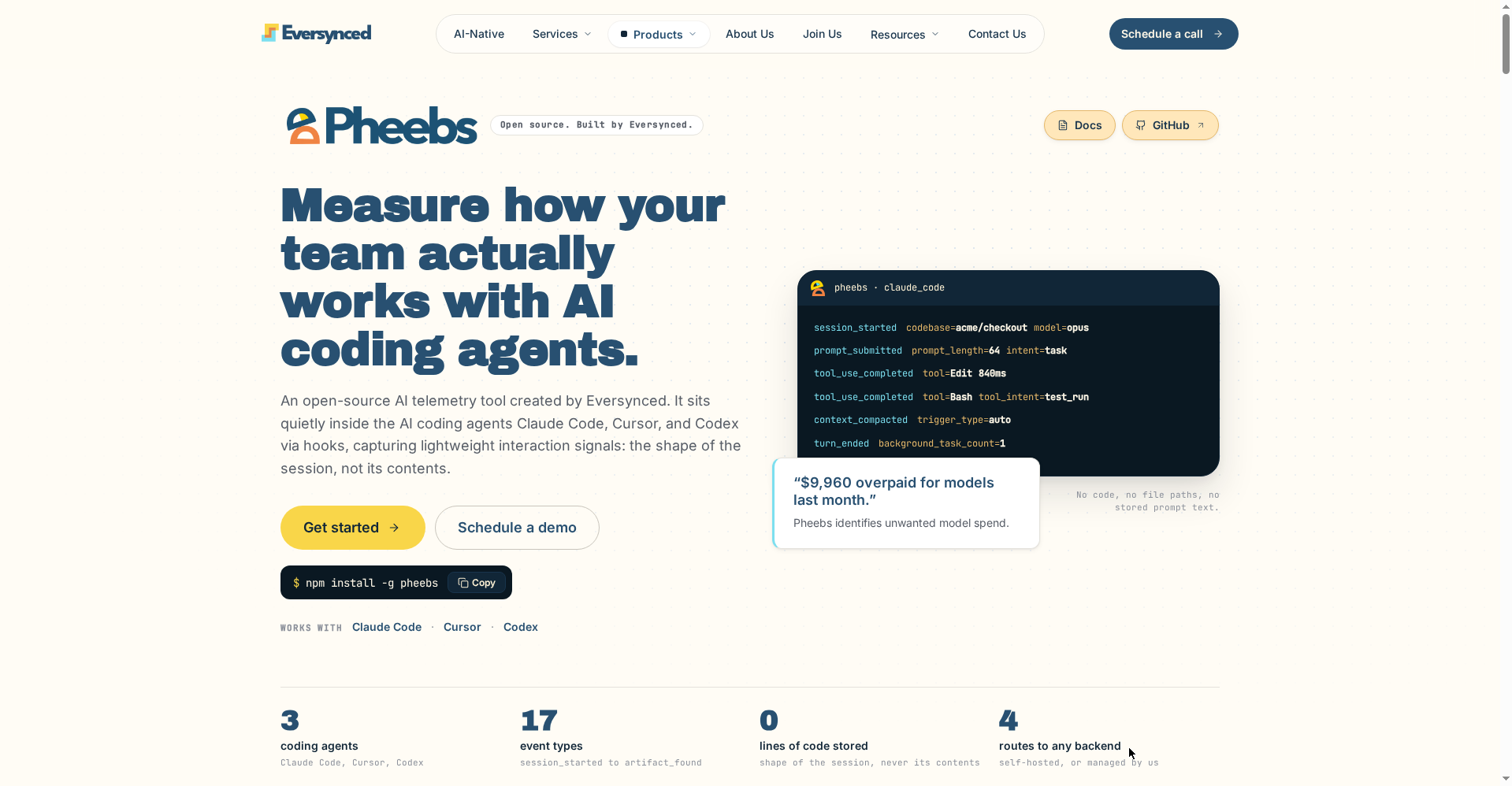
Pheebs, built by Eversynced, is an open-source telemetry tool for AI coding agents. It answers the question every engineering leader is quietly asking: we’re spending a fortune on AI coding agents — but what’s actually happening inside those sessions?
Adoption dashboards tell you who has access. They say nothing about which models get used on which tasks, whether a bigger model ran on trivial work (silent budget burn), or whether AI-written code ships without a test. Pheebs captures exactly that layer.
Key features (what sets it apart)
1. Hooks into the three big coding agents
Pheebs sits inside Claude Code, Cursor and Codex via hooks. Session starts and ends, prompt submissions, tool calls and failures, model switches, compaction, background tasks — each becomes a lightweight event. There are 17 event types in total, from session_started to artifact_found.
2. Privacy-first: the shape of the session, never its contents
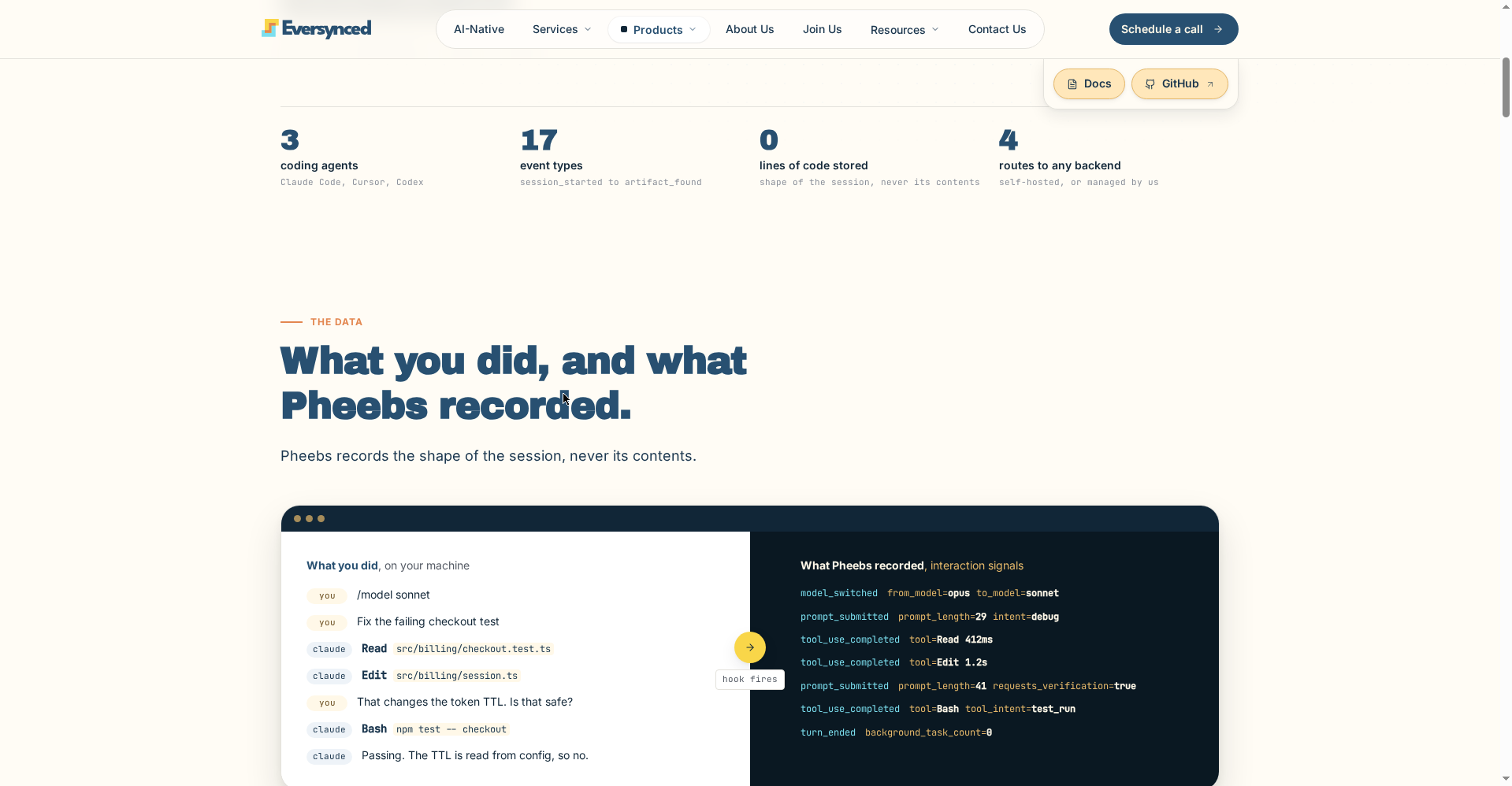
This is the design decision that makes Pheebs interesting. What it captures:
- Event types, durations, counts, models, trigger types
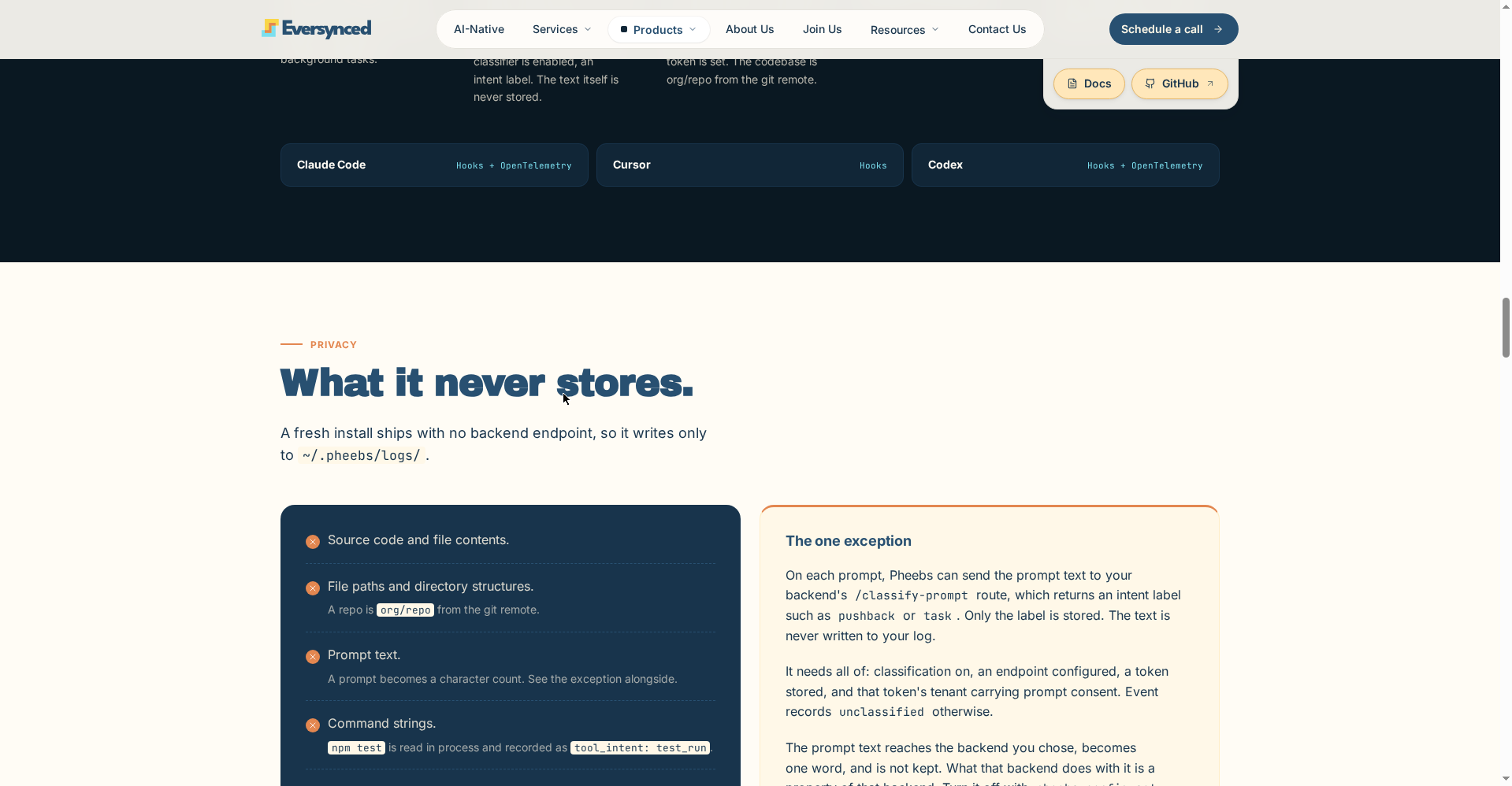
- Only the character count of a prompt (plus an intent label if you enable the classifier) — never the text
- Commands like
npm testare read in-process and recorded astool_intent: test_run— the raw command is never stored
What it never captures: source code, file contents, file paths, prompt text, names, emails. Your identity is just the ID behind your token — or a truncated hash of your git email when no token is set.
3. Local-first — your data, your machine
Every event is first written to a local JSONL log at ~/.pheebs/logs. It only reaches a backend if you set both base-url and token; unset either one and sending stops. The local JSONL stays the durable copy either way. You can self-host (there’s a documented backend contract plus a reference implementation in the repo) or use Eversynced’s managed option.
4. The AI Proficiency Model — a framework for reading the data
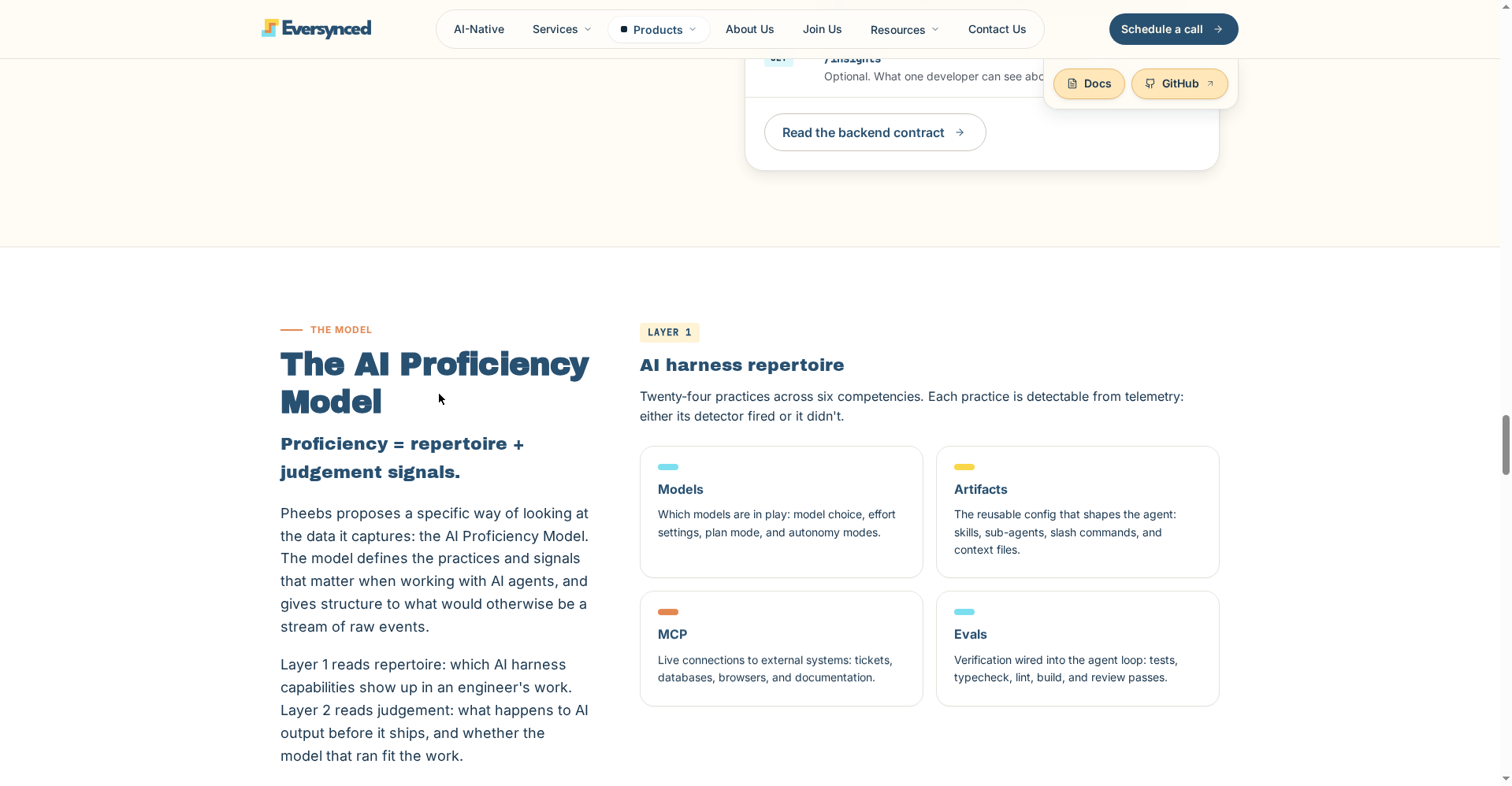
A raw event stream is just noise, so Pheebs ships with the AI Proficiency Model: a structured way to interpret what it captures.
- Layer 1 (Repertoire): 24 practices across 6 competencies — Models, Artifacts (skills, sub-agents, slash commands), MCP, Evals (tests/lint/build), Context management, Orchestration
- Layer 2 (Judgement signals): Does AI output get verified before it ships (verification coverage)? Do engineers challenge it or accept it wholesale (pushback rate)? Do follow-ups refine intent or repair breakage (refinement-to-repair ratio)? Did the model fit the size of the work (model-fit rate)?
5. Prices your overspend in dollars
The site’s illustrative example: of a team’s $32,400 in monthly model spend, $9,960 (31%) went to bigger models than the work needed. Pheebs prices the model-fit gap in real dollars — a number an engineering manager can actually take to a budget meeting.
Pricing — what do you get for free?
- Open source (self-hosted): Completely free — Apache-2.0 license, the full client for all three agents. Run your own backend; telemetry goes to your infrastructure. No account, no key from Eversynced.
- Managed (AI Enablement Assessment): A 30-day telemetry sprint — Eversynced operates the backend and maintains the proficiency reports and dashboards, ending in an executive debrief plus an improvement plan. Pricing is not published on the site.
Who should use it — and who shouldn’t
- Engineering managers & CTOs: If AI coding agents are in serious use and you want to understand ROI, catch silent overspend, or find quality gaps (AI code shipping untested) — this was built for you.
- DevOps / platform teams: Self-host the backend and query the raw JSONL with whatever you already use.
- Solo developers: The local mode is free and great for understanding your own AI habits — but you won’t get team-level insights.
- Non-developers: This is strictly a developer tool — not for marketers or content creators.
Final verdict
Pheebs solves a real problem in every AI-first engineering team: “We’re spending heavily on AI — but nobody can see what’s happening inside those sessions.” The privacy-first architecture is genuine (it’s open source, so you can verify the claims), the local-first design is sensible, and pricing the model-fit gap in dollars is a smart business insight.
We docked half a point because only three agents are supported so far and it’s still early — the ecosystem needs time to mature.
Our rating: 4.5/5. If your team uses AI coding agents seriously, it’s worth installing — and it’s free.
Note: This is a first-look review based on the official site (eversynced.com/pheebs) and the public GitHub repo (eversynced/pheebs). We’ll update it with hands-on testing after installing it ourselves.