 AI Tool
⚡ Decide in 30 seconds
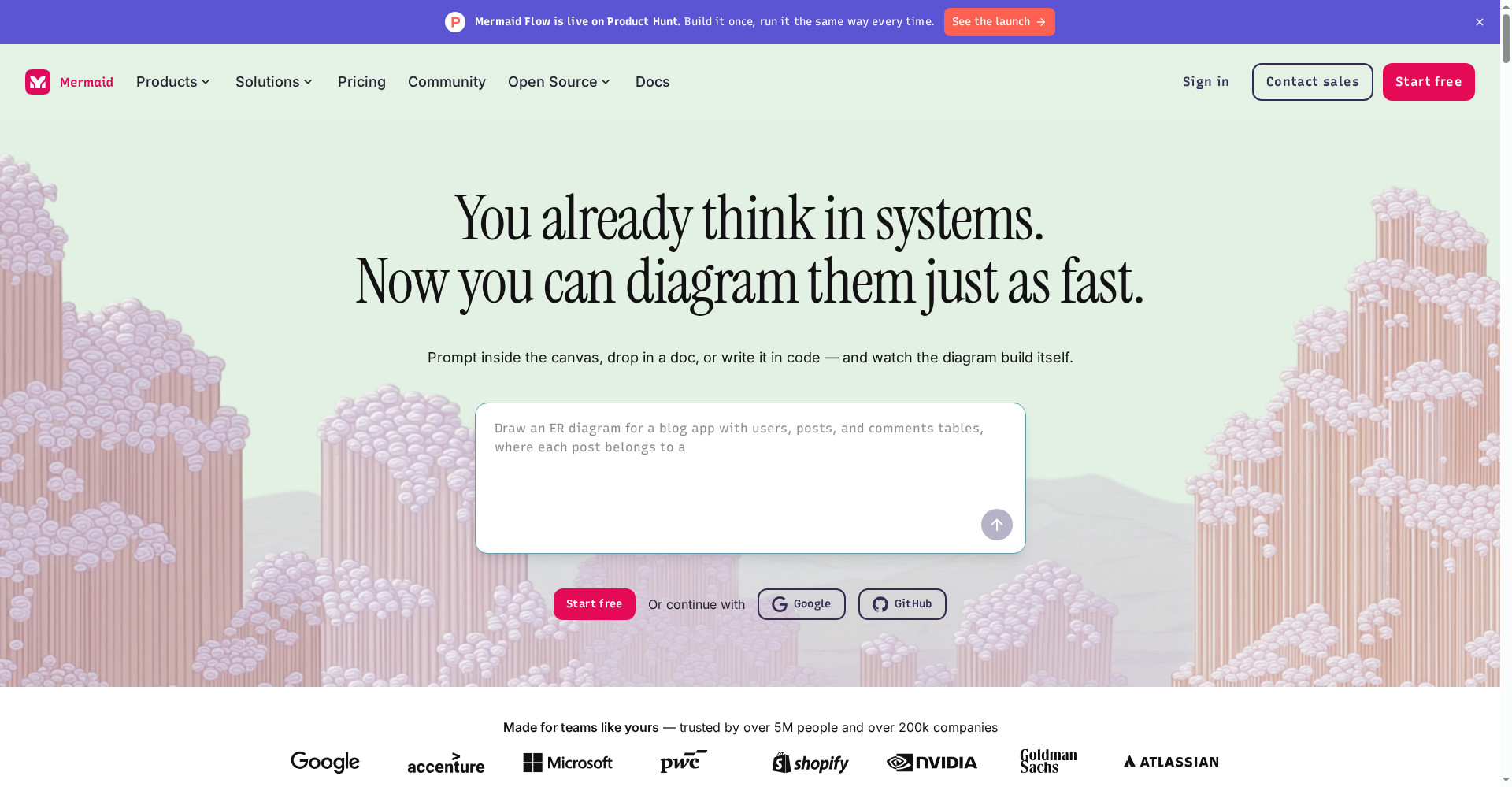
Mermaid Flow is a visual builder (mermaid.ai/flow) that turns your repeatable AI work into a diagram — and runs it the same way every time, no matter who presses run. Issue triage, the weekly recap, a PR first-read and release-notes drafts: build once, run in one click, every time. The free plan includes 15 runs a month; Plus is $10/user/month and Premium is $20/user/month (annual billing only). Launched on Product Hunt on 18 November 2026. For students, freelancers and small teams with work that repeats every week and should stay visible to the team, it is worth trying — build one real workflow on the free plan and test it across your 15 runs before deciding whether a paid plan is needed.
What is this tool?
Every team has work that repeats every week — triaging new issues, writing the weekly recap, giving every PR a first read, drafting release notes. Today that work often runs through AI in a chat window: paste the prompt from a doc, adjust it a little, run it again. After a few weeks the output starts to drift — and nobody can quite say why, because there is nothing to compare it against. Each teammate keeps their own copy, and “how we triage issues” quietly becomes five slightly different prompts.
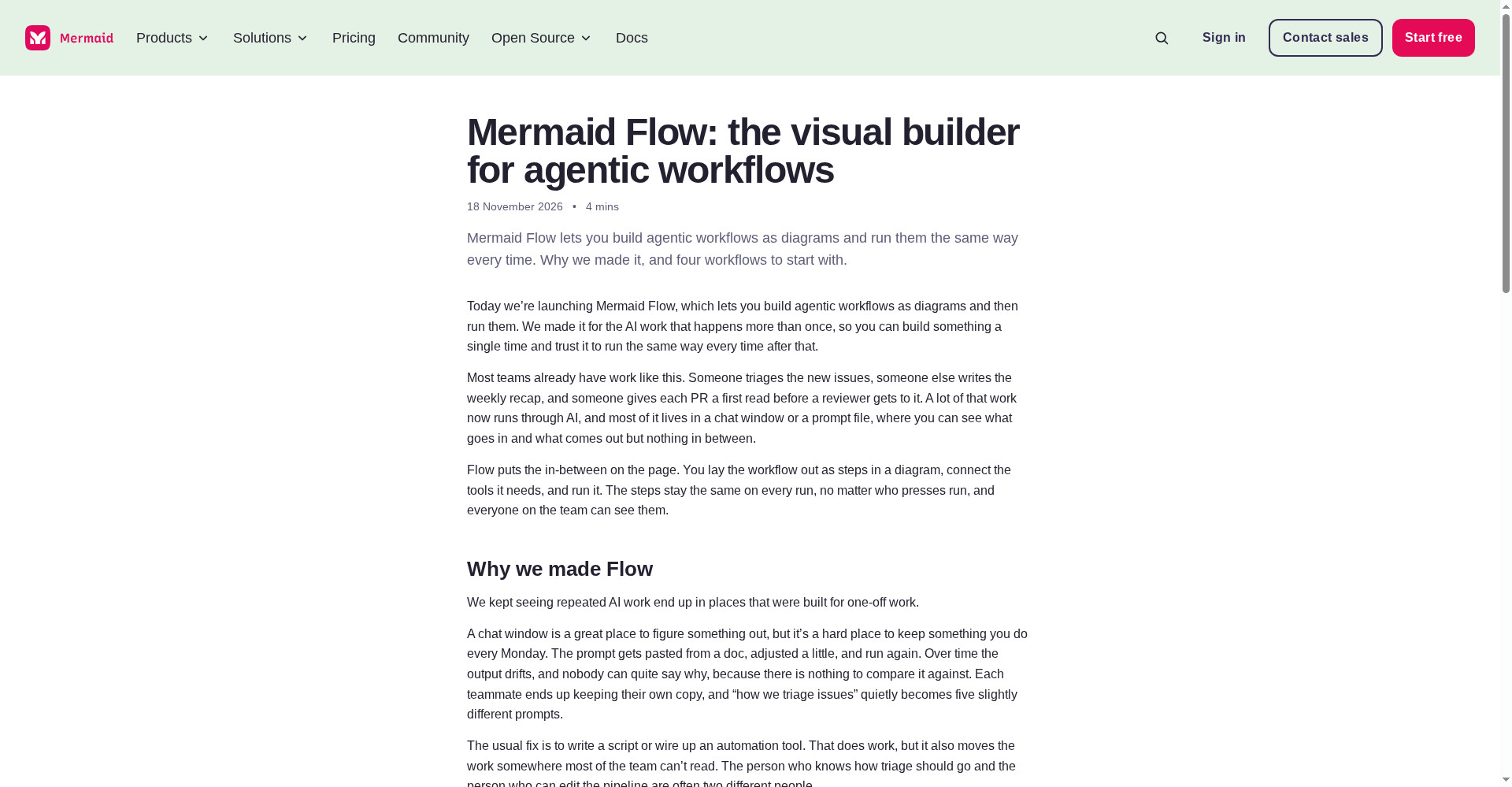
Mermaid Flow is built for exactly this problem. The official blog puts it in one line: the picture you would draw to explain the work to a new teammate is now the thing that runs.
It works simply: lay the workflow out as steps in a diagram, connect the tools it needs, and run it. The model still does the thinking inside each step, but it does not get to decide what the steps are — you do. The steps stay the same on every run, and every step in between is visible on the page — so if a result looks off, you know where to look.
In plain words: Mermaid Flow takes your repeatable AI work out of the dark of a chat window and puts it in a clean diagram — one everyone can read, that runs the same way every time.
Key features (what makes it different)
1. The steps are fixed — the model thinks, it does not decide the steps
This is Flow’s biggest difference. Give a job to a general AI agent and it decides for itself how to do it — and does it slightly differently every time. In Flow, you set the steps, and they run in the same order every time. The model only does the thinking inside each step. In other words: once you build a workflow right, it runs right every time — whether you press run or your teammate does.
2. You can see the middle — the “in-between” is on the page
In a chat window you only see the input and the output — never what happened in between. In Flow, every step between input and output is on the page. If a result looks strange, you can go straight to the step where it went wrong. The official blog calls this Flow’s core: “Flow puts the in-between on the page.”
3. There is one copy — the whole team runs the same workflow
When the workflow is a diagram, the whole team can read it — and anyone who runs it gets the same steps as the person who built it. Nobody keeps their own copy, nobody tweaks their own prompt. How triage works is one shared truth for the team, not five different prompts.
4. Four ready-made starting points — a first workflow in minutes
The official blog names four workflows that are small enough to build in minutes:
- Triage every issue: When a new issue comes in, Flow reads it, applies the labels you already use, checks for duplicates, and sends it to the right owner.
- Recap the week: Schedule it for Friday afternoon — Flow gathers what shipped, what is still open and what is blocked, then posts the summary wherever your team already reads updates.
- Give every PR a first read: Before a reviewer opens it, Flow summarizes the change, checks it against your own review checklist, and flags the parts that need a person.
- Draft the release notes: Flow collects the work merged since the last release, groups it, and writes a draft in your format for someone to edit.
5. The Mermaid ecosystem — diagrams where you already work
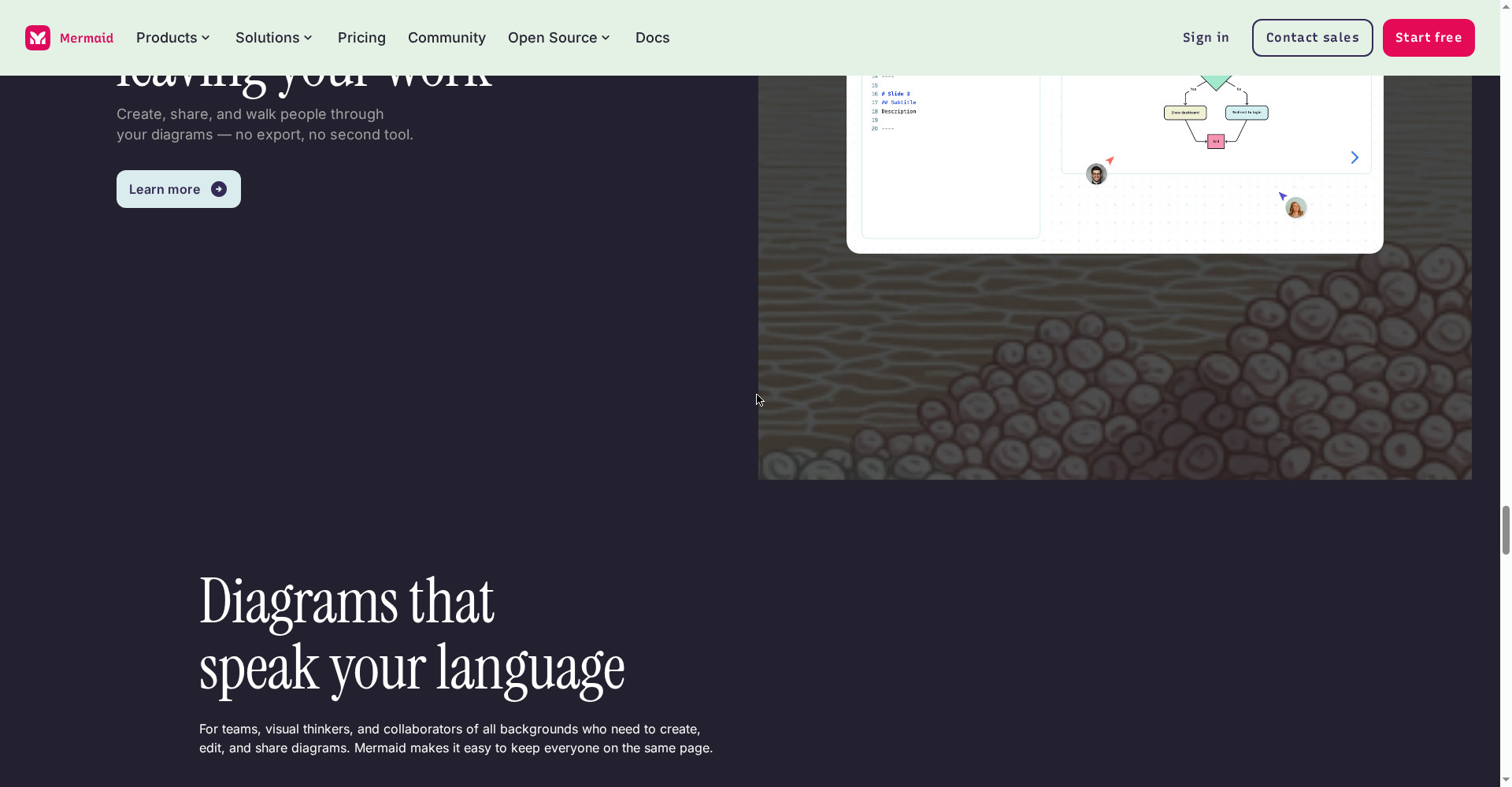
Flow does not stand alone — it is part of Mermaid, the same open-source library (MIT licence, 90k+ GitHub stars) whose diagrams render natively in GitHub, Notion and Obsidian. Mermaid supports 20+ diagram types — flowcharts, sequence, class, state, ER, Gantt, mind maps, timelines and more. The homepage says over 5M people and 200k+ companies use Mermaid. Integrations include GitHub Copilot, Confluence, Jira, Google Docs, VS Code, JetBrains and Cursor. And the mermaid.live editor is always free — build and export a diagram with no sign-up.
Pricing — how much is free?
- Basic — Free ($0): 15 Flow runs/month per user, 15 AI credits, a few diagrams (the official site shows 3 diagrams on the plan card and up to 6 in the comparison table), diagram size limit of 60, 1 team and 1 project. The Mermaid syntax and the mermaid.live editor are always free.
- Plus — $10/user/month (annual billing, $120/year): Unlimited diagrams, limitless diagram size, 300 AI credits/year, 15 Flow runs/month per user. Free trials of Plus and Premium are available.
- Premium — $20/user/month (annual billing, $240/year): Everything in Plus + 2,000 AI credits/year, unlimited viewer seats, 500 shared Flow runs/month for the whole organization, unlimited teams and projects.
- Enterprise — Custom (annual): Everything in Premium + SSO, dedicated account support, custom contract and invoicing, user consolidation.
The honest maths: 15 free runs a month are enough to test one workflow — if you have one repeating job that runs 3–4 times a week, the free plan may be all you need. But anyone running two or three workflows a day will hit the cap within a week, and then Premium ($240/year) is the only step up — there is no light paid plan in between. And note: there is no monthly billing at all — Plus or Premium means paying for the whole year up front. Run your real workflow on the free plan first — if the 15 runs start paying off before they run out, only then think about paying.
Platforms
- Web: mermaid.ai/flow — runs in the browser after sign-in (continue with Google or GitHub)
- Mermaid hosted editor: Build diagrams with AI, code or clicks; real-time collaboration and share links
- mermaid.live: The free live editor — no sign-up, right in the browser
- Integrations: GitHub Copilot, Confluence, Jira, Google Docs, Microsoft Word and PowerPoint, VS Code, JetBrains IDEs, Cursor
- Diagram types: 20+ — flowchart, sequence, class, state, ER, Gantt, mind map, timeline, Kanban, Sankey and more
- Company: Mermaid — the team of Knut Sveidqvist, creator of open-source Mermaid.js; the hosted product now lives at mermaid.ai
- Launch: Launched on Product Hunt on 18 November 2026; the homepage carries a “Mermaid Flow is live on Product Hunt” banner
Who should use it, and who should not?
- Students: Turn an assignment process, study plan or project steps into a diagram and run it the same way every week — start with the free 15 runs a month.
- Freelancers: Put repeating work like client onboarding, weekly status updates or invoice follow-ups into one workflow — the same steps for every client, no step skipped.
- Small teams / founders: For work that happens every week, like issue triage and the weekly recap — build the workflow once, then the whole team runs it.
- Developers: PR first-reads and release-notes drafts — diagrams version with the code, so the workflow itself can be reviewed.
- Should not: Anyone whose job only needs doing once — a chat or a script is faster, and building a Flow would be wasted time. Anyone who needs thousands of app integrations — look at Zapier or n8n, Flow is brand new. Anyone who needs monthly billing — only annual exists here.
Comparison: Zapier / n8n
- Zapier (free: 100 tasks/month; Professional $19.99/month): The biggest name in general automation — thousands of apps, two-step automations in minutes. But Zapier counts tasks (every step is a task), and the steps stay hidden in a list — the team never sees what happened inside the workflow. Mermaid Flow is different: the diagram is the workflow, the steps are visible to everyone, and AI does the work inside each step. If you just need to connect apps, use Zapier; if you need repeatable AI work to stay transparent, use Flow.
- n8n (self-hosted free; Cloud Starter €20/month annual billing, 2,500 executions): For technical teams — self-host it and get unlimited workflows (you pay for the server). On Cloud, a whole execution is counted, not each step. Flow is simpler: no server, no node wiring — draw the diagram and run it. But n8n has far more integrations and control, and it has been mature for years; Flow is one day old. Developers who want full control should pick n8n; a non-technical team that wants a straightforward visual way should pick Flow.
- Make (Core ~$9/month annual billing): Visual scenarios with branching and loops — like Zapier, a little cheaper. The difference from Flow is the same: in Make an automation is a scenario, in Flow it is a diagram the team can read.
🔍 People also search for
- mermaid flow
- mermaid flow free
- mermaid flow pricing
- mermaid flow review
- mermaid flow vs zapier
- mermaid flow vs n8n
- mermaid flow login
- mermaid ai pricing
- mermaid chart free
- mermaid live editor
- ai workflow automation free
- zapier free plan
- n8n pricing
- irisgo review
- turnstone review
- openpilot review
- stitch review
- hob review
Final verdict
Mermaid Flow is a straightforward, sensible idea — take repeatable AI work out of the dark of a chat window and put it in a diagram that everyone can read and that runs the same way every time. Fixed steps, a visible middle, one copy, 15 free runs a month, and the large Mermaid ecosystem behind it — that combination works for anyone whose work repeats every week. The honest cuts: the tool is one day old (launched 18 November 2026), the free plan gives only 15 runs, billing is annual only, and seeing the Flow builder needs a sign-in.
Our rating: 4/5. If you are a student, freelancer or small team with work that repeats every week — build a free account at mermaid.ai/flow and test one real workflow across your 15 free runs. Try a free diagram on mermaid.live first — the same syntax runs in Flow. If you only need to connect apps, look at Zapier; if you need full technical control, look at n8n — but if you need repeatable AI work to stay transparent to the team, Mermaid Flow is worth a look.
Note: This first-look review is based on the official site (mermaid.ai), the official pricing page, the launch blog post (18 November 2026) and the Product Hunt launch. The Flow builder needs a sign-in, so we will add a hands-on update once we have used it ourselves.